Friday, 4 April 2014
Weavesilk; My experiment in stages
As part of Art and Design in computers I tried my hand at Weavesilk. What I have done here is to show in stages the progression of my work. The 1st picture is an attempt of just a few lines in 2 fold rotational symmetry, the 2nd picture shows 3 fold rotational symmetry added to it. The 3rd shows 4 fold, then 5 fold and finally the 5th picture shows my completed Weavesilk experiment in 6 fold rotational symmetry added to all 2, 3, 4 and 5 fold past experiments.
Friday, 31 January 2014
Cubism and Cubist Artists
There is a debate over who invented Cubism, however for a painting to be a true cubist painting it must involve the three main ingredients which are:
GEOMETRICITY: Simplified objects and figures which may or may not result in the whole figure or object resembling that which we know in the natural world. It is also an approximation of the 4th dimension and is conceptual instead of perceptual reality.
PASSAGE: Overlapping and interpenetration of planes.
SIMULTANEITY: Different points of view made visible on one plane. Multiple views of objects and figures.
The argument goes that either Georges Braque or Pablo Picasso invented Cubism. Textbooks often hail Picasso's Les Demoiselles d'Avignon as the first Cubist painting as it involved the three main ingredients of Cubism; Geometricity, Simultaneity and passage. However this painting was not displayed until 1916, even though painted in 1907.
Georges Braque however delivered a series of paintings and many say that Houses at L'Estaque is the first Cubist painting which was influenced by Cezannes landscapes and painted in 1908. These paintings by Braque also urged art critic Louis Vauxcelles and Henri Mattisse to describe the paintings to be 'nothing but little cubes'. Hence the name Cubism was formed.
I think it fair to say that both Braque and Picasso created cubism, which was further developed by Juan Gris, who is described as the Third Cubist Painter. His paintings are described as more calculated than Picasso's and Braque's, with every line, shape, tone, colour and pattern being carefully refined.
There are four 'Cubism' periods.
Early Cubism or Cezannism (1908 - 1910)
Analytic Cubism (1912 - 1914)
Late Cubism (1915 - present)
GEOMETRICITY: Simplified objects and figures which may or may not result in the whole figure or object resembling that which we know in the natural world. It is also an approximation of the 4th dimension and is conceptual instead of perceptual reality.
PASSAGE: Overlapping and interpenetration of planes.
SIMULTANEITY: Different points of view made visible on one plane. Multiple views of objects and figures.
The argument goes that either Georges Braque or Pablo Picasso invented Cubism. Textbooks often hail Picasso's Les Demoiselles d'Avignon as the first Cubist painting as it involved the three main ingredients of Cubism; Geometricity, Simultaneity and passage. However this painting was not displayed until 1916, even though painted in 1907.
Georges Braque however delivered a series of paintings and many say that Houses at L'Estaque is the first Cubist painting which was influenced by Cezannes landscapes and painted in 1908. These paintings by Braque also urged art critic Louis Vauxcelles and Henri Mattisse to describe the paintings to be 'nothing but little cubes'. Hence the name Cubism was formed.
I think it fair to say that both Braque and Picasso created cubism, which was further developed by Juan Gris, who is described as the Third Cubist Painter. His paintings are described as more calculated than Picasso's and Braque's, with every line, shape, tone, colour and pattern being carefully refined.
There are four 'Cubism' periods.
Early Cubism or Cezannism (1908 - 1910)
Analytic Cubism (1912 - 1914)
Late Cubism (1915 - present)
![]() |
| Pablo Picasso: Les Demoiselles D'Avignon |
![]() |
| Georges Braque: Houses at L'Estaque |
![]() |
| Juan Gris: Harlequin with Guitar |
Tuesday, 7 January 2014
Inspiration for Urban Landscape final piece: John Piper and L S Lowry
For my final piece for the Urban Landscape project my inspiration came from art mainly created by John Piper and L S Lowry, however I did ponder whether I should go into a more abstract form of art. Never the less I felt that for this particular assignment; buildings, town and city scenes, urban life, I wanted to paint a picture that showed the observer the streets and buildings of the city rather than focus on shapes and colours that show a hint of the scene I had in mind to project.
Both John Piper and L S Lowry, in my opinion created scenes which are recognisable and yet show personality and imagination. I also feel there is a sense of freedom with both Piper and Lowry to paint a picture the way they felt it should look rather that how it may actually appear in real life.
I was taken by John Piper's art and found his choice of scenes to paint to be most impressive. Without too much emphasis on a very life like painting his art shows brilliant colour and imagination. I felt I leaned towards the style of John Piper whilst attempting my own urban landscape scene. His colours are quite over the top and enhanced and I wanted to deliver strong saturated colours in my art.
L S Lowry who was famous for his paintings of the North of England in the mid 20th century and his matchstick men was a huge inspiration to me. I liked his naive approach to painting and again I liked his use of colour within the dusty streets and scenes. Because of this I felt an urge to paint old mills and grotty smokey scenes also but I chose a scene which had both yesterdays buildings and today's more modern buildings together.
My final piece is taken from a photograph I took of a scene in Manchester and I wanted to show buildings both old and new.
Monday, 16 December 2013
Liz Brizzi: Mixed Media Landscape Artist
Lately I have become quite enthusiastic regarding mixed media art. Therefore I decided to research urban landscape artists that use this style of art for their work and I came across Liz Brizzi who's art work stands out with quality and seems to reflect desolation and decay. She seems to have found the knack of producing work with that scratchy and distressed atmosphere whilst still retaining colour.
Reading up on Liz Brizzi I find that her inspiration for her art comes from the industrial aspects of big cities and she has created numerous pieces centred around LA.
Liz's unique style starts with her own original photographs. She works with the idea of a 'mood' of a painting and uses the photographs she has that 'speak to her', tweaking them on photoshop, cutting them and creating a photo montage. Liz then places this photo montage onto an acrylic painted wood panel and then blends with layers of colourful acrylic washes.
Below are some examples of her work.
Reading up on Liz Brizzi I find that her inspiration for her art comes from the industrial aspects of big cities and she has created numerous pieces centred around LA.
Liz's unique style starts with her own original photographs. She works with the idea of a 'mood' of a painting and uses the photographs she has that 'speak to her', tweaking them on photoshop, cutting them and creating a photo montage. Liz then places this photo montage onto an acrylic painted wood panel and then blends with layers of colourful acrylic washes.
Below are some examples of her work.
Quick Sketches
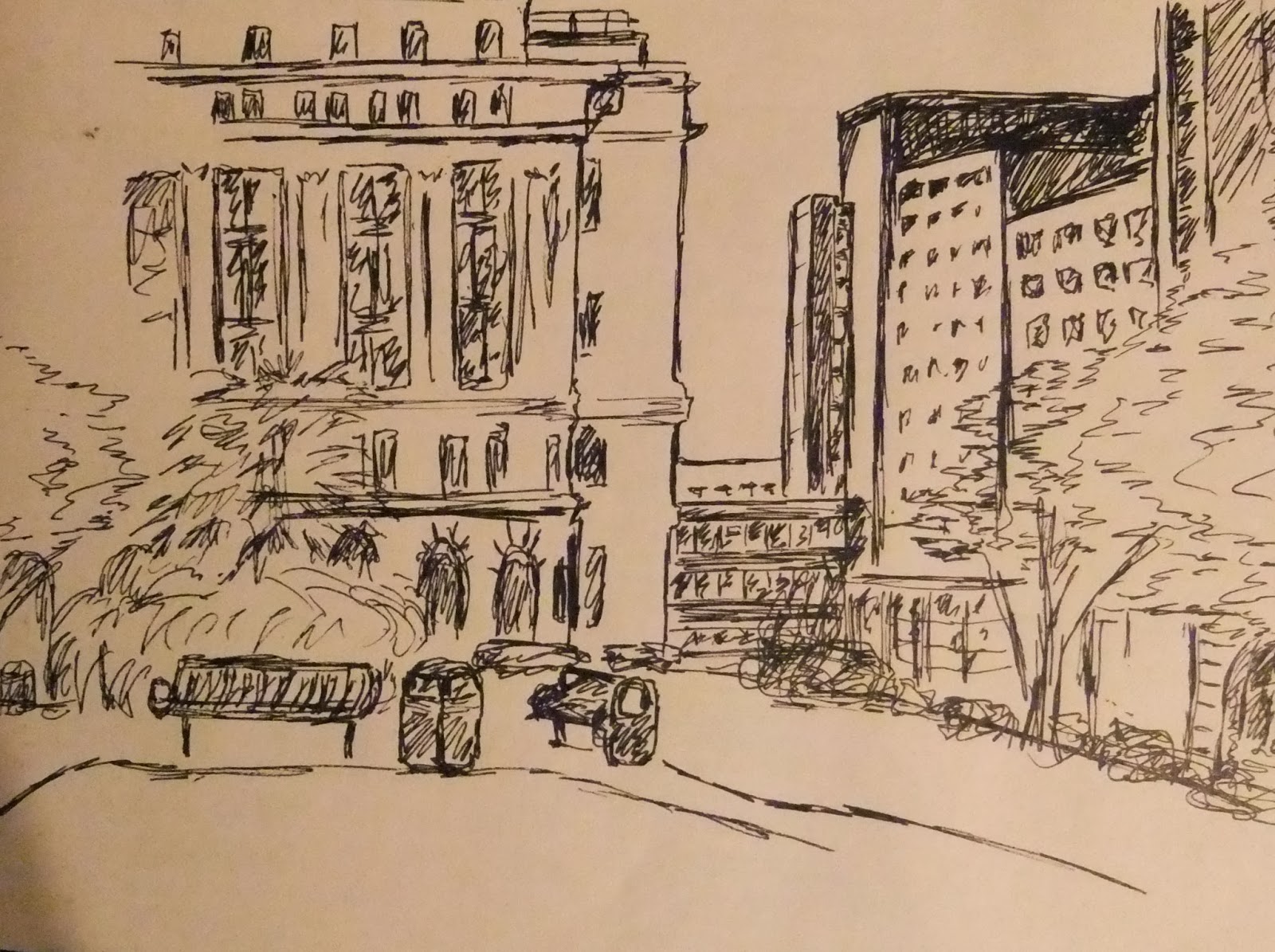
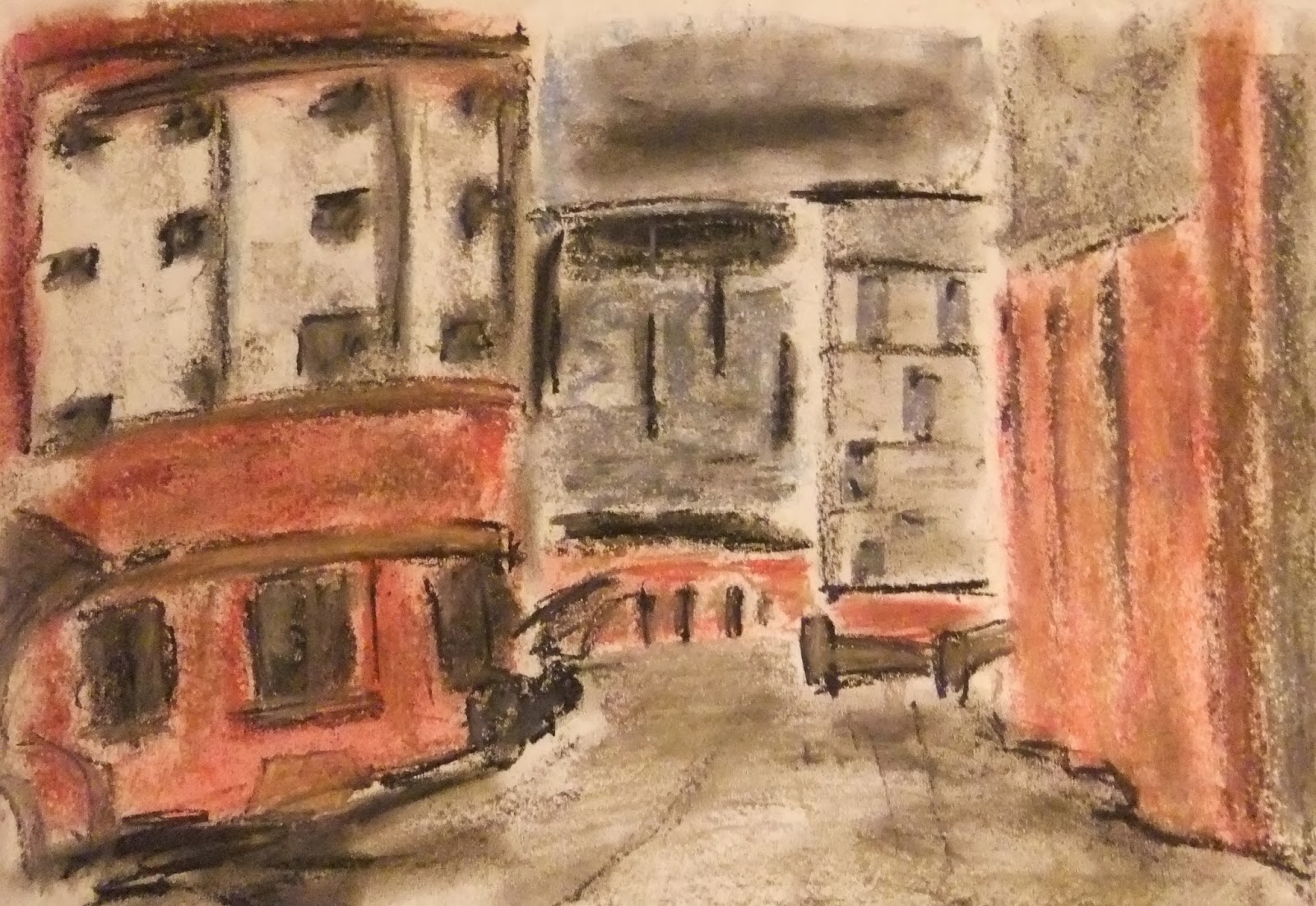
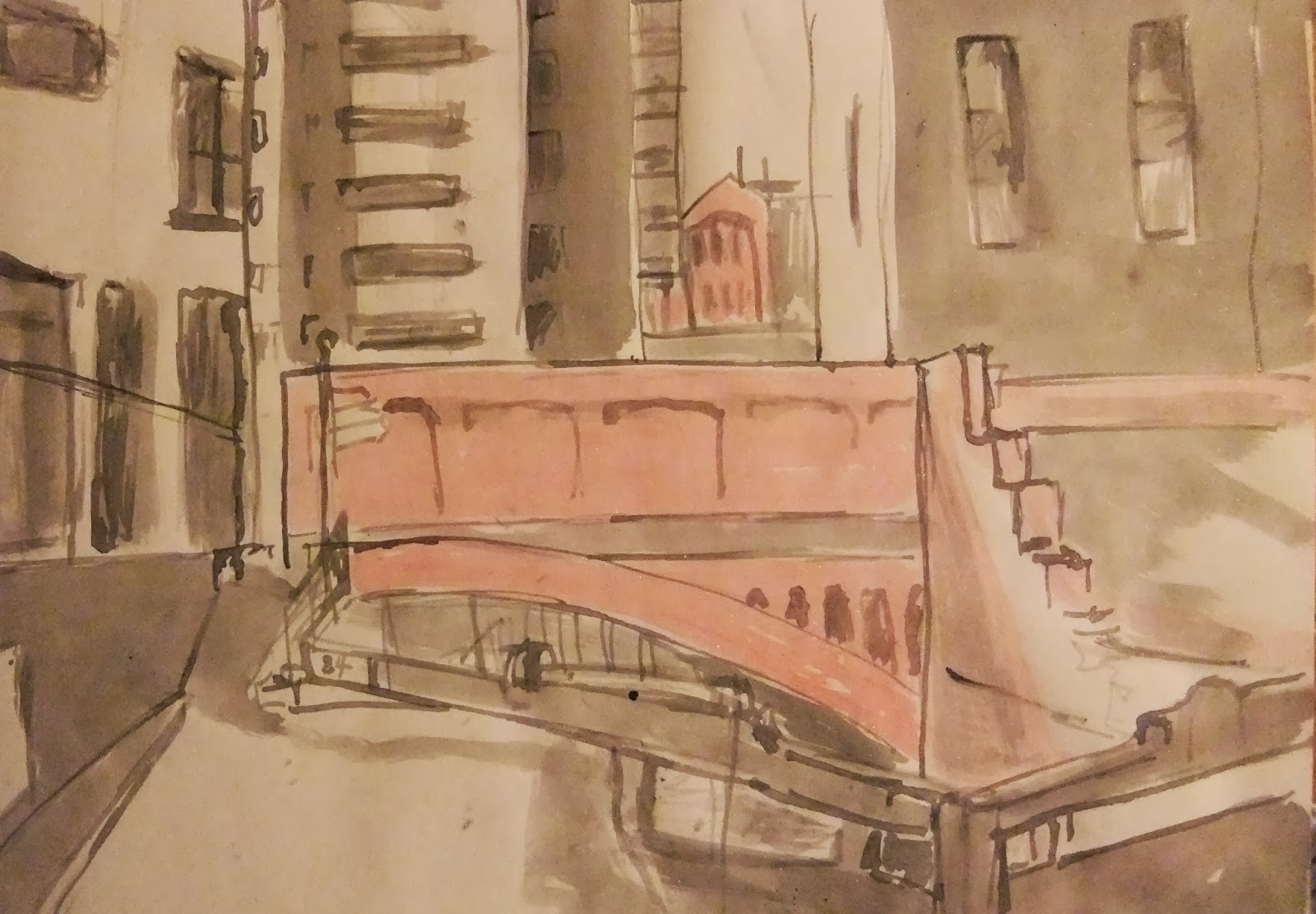
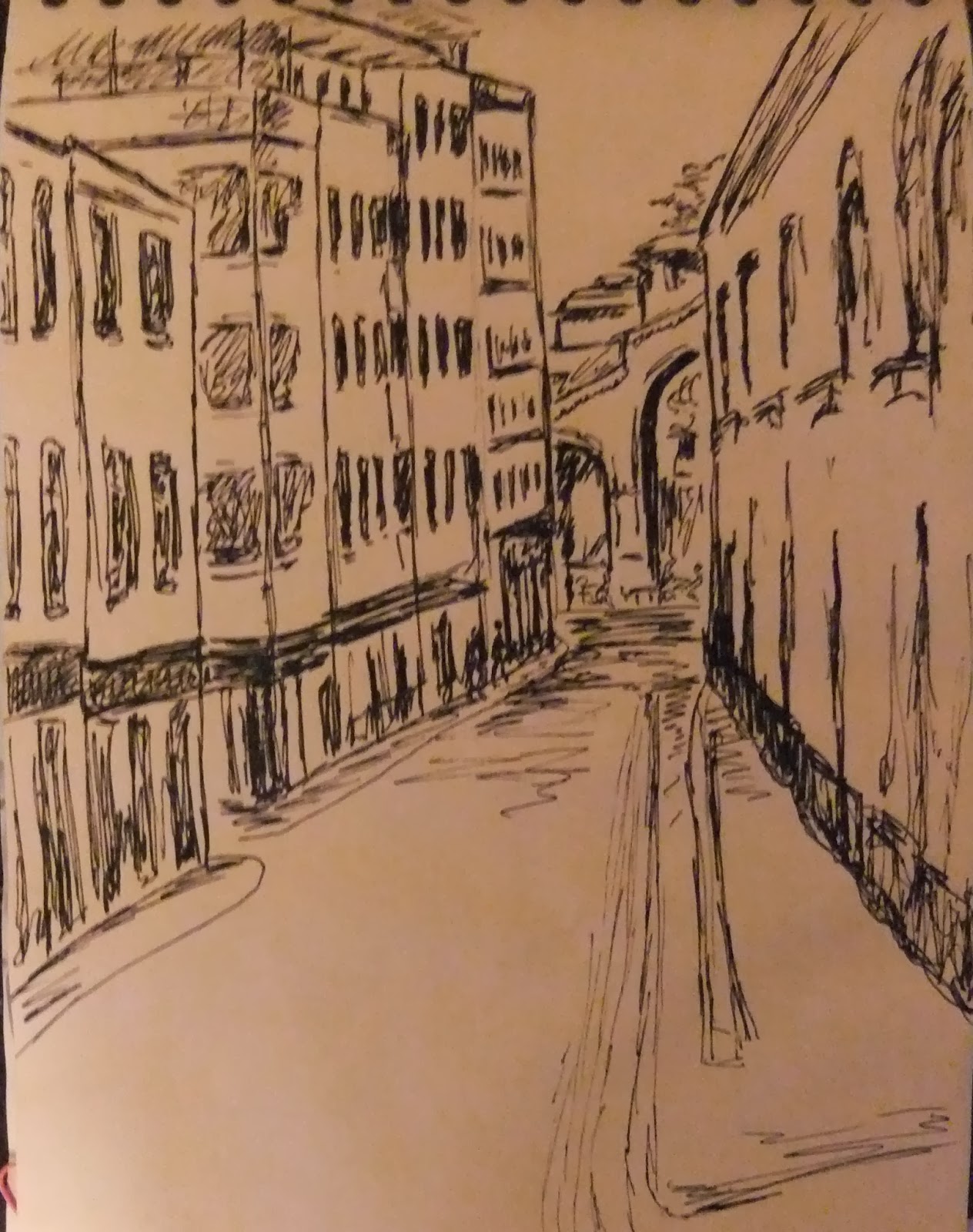
I have found that Sketches can be a good way to find out if a scene works for me and therefore helping me to make the decision as to whether to work with that scene in a larger or more complex project.
Here are some of my sketches that I have completed during my time at college:
![]() |
| Sketch from life using ink pen |
![]() |
| sketch from life using soft pastels |
![]() |
| sketch from photo using red and black ink |
Urban Landscape Artists Research: Nathan Walsh
Nathan Walsh is an interesting artist, not only because his paintings are extremely life like but because his artistic technique involves extremely complex drawings resembling that of an architechural blueprint.
Many artists use a camera or computer software for the base of their paintings and work with that to complete their finished piece, however Nathan Walsh interestingly rejects this technique and instead relies on his drawings of certain chosen scenes. Walsh prefers to use his Human eye therefore giving him the chance to make pictorial decisions. With mathematical structure he is able to give his art a sense of 'real life'. His Paintings are geometrically perfect looking but actually give a sense of perhaps 'bent space'. This could question the Human eye's perception of the world and that which surrounds us.
"Working with a box of pencils and an eraser I will start establishing an horizontal line on which I will place vanishing points to construct simple linear shapes which become subdivided into more complex arrangements." Nathan Walsh.Walsh's paintings take up to three or four months to complete. Here are some examples of his work.
Sunday, 15 December 2013
Urban Landscape final piece: Evaluation
After careful consideration regarding the many different ways I could achieve my final piece I decided to use acrylic paints. I have enjoyed using watercolour, soft pastel, ink, etc (please see previous post) however I wanted to put forth a painting which looked almost saturated in colour and so I decided that acrylic paints were possibly a good option to use for this effect.
When it came to starting the painting I knew that the way I work tends to involve 'not putting the paint brush down'. I realise that I work best this way and if I put a painting away for a few days I may not finish it. I tend to work intensely for most of the day or days for that matter in order to get a piece of art finished. This particular painting was done over two days using acrylic paints, brushes, card and sponge from one of my own photographs of an urban landscape scene in Manchester. I started by painting a pale cream/yellow background with a wide brush, and then using the card I scraped the shapes of the different buildings onto the canvas. Then I started to add the detail, slowly building the painting up. After taking the painting to college and having words with Tony I decided to work more on the painting as I felt that some of it was a little too harsh especially the blacked out part in the bottom left hand corner, so I lightened the original photograph on my computer so I see more of the detail in the darker areas and then I painted in those parts over the blacked out area.
Here are photographs of the stages of my painting before completion.
When it came to starting the painting I knew that the way I work tends to involve 'not putting the paint brush down'. I realise that I work best this way and if I put a painting away for a few days I may not finish it. I tend to work intensely for most of the day or days for that matter in order to get a piece of art finished. This particular painting was done over two days using acrylic paints, brushes, card and sponge from one of my own photographs of an urban landscape scene in Manchester. I started by painting a pale cream/yellow background with a wide brush, and then using the card I scraped the shapes of the different buildings onto the canvas. Then I started to add the detail, slowly building the painting up. After taking the painting to college and having words with Tony I decided to work more on the painting as I felt that some of it was a little too harsh especially the blacked out part in the bottom left hand corner, so I lightened the original photograph on my computer so I see more of the detail in the darker areas and then I painted in those parts over the blacked out area.
Here are photographs of the stages of my painting before completion.
Subscribe to:
Posts (Atom)